SERVICES
 |
|
 |
|
 |
|
 |
|
 |
|
 | |
 | |
 |
|
 |
|
 |
|
 |
|
 |
|
 |
|
 |
|
 |
|
Products
IOS has extensive experience providing EPC services throughout all of Iraq .With our best in class engineering services, decades-long ties with third-party suppliers, and strong relations amongst local Iraqi construction resources, we are able to provide our clients with full turnkey EPC solutions.
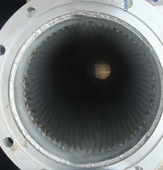
IOS produce either a welded or seamless pipe.Raw steel is first cast into a more workable starting form. It is then made into a pipe by stretching the steel out into a seamless tube or forcing the edges together and sealing them with a weld. The first methods for producing steel pipe were introduced in the early 1800s, and they have steadily evolved into the modern processes we use today. Each year, millions of tons of steel pipe are produced. Its versatility makes it the most often used product produced by the steel industry. There are three processes for metallic pipe manufacture. Seamless pipe is formed by drawing a solid billet over a piercing rod to create the hollow shell. Seamless pipe provides the most reliable pressure retaining characteristics, and is often more easily available than welded pipe. Welded (also Electric Resistance Welded (ERW) and Electric Fusion Welded (EFW)) pipe is formed by rolling plate and welding the seam. The weld flash can be removed from the outside or inside surfaces using a scarfing blade. The weld zone can also be heat treated, so the seam is less visible. Welded pipe often has tighter dimensional tolerances than seamless, and can be cheaper if manufactured in the same quantities. Large diameter pipe (about 10 inches or greater) may be ERW, EFW or Submerged Arc Welded (SAW) pipe..
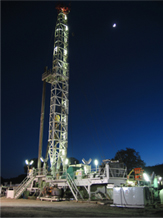
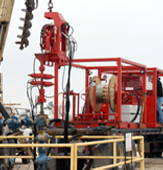
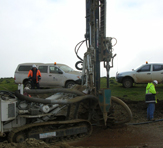
INTEGLOABAL OIL SERVICES drilling rig is designed and manufactured according to the principle "advanced performance, reliable operation, convenient mobilization, economic operation and meeting middle east requirements". The performance and quality has reached or are beyond the advanced level of international similar drilling rigs.
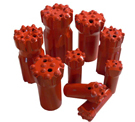
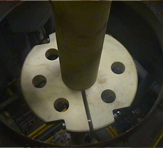
The core drilling bits supplied by( INTEGLOABAL OIL SERVICES) are designed for coring operations in the Mineral Exploration, Gas and Oil, and Geotech Industries. The core-drilling bit disintegrates only the circumferential surface of bottom hole, whereas its central part (core) remains intact.
Adapters - Casinghead
Adapters - Tubinghead
Ball Valves - Full Opening
Bell Nipples
Bull Plugs
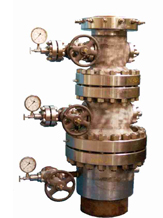
Casingheads
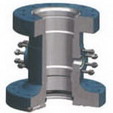
Casing Spools
Chokes - Positive
Chokes - Manual Adjustable
Chokes - Hydraulic
Flanges - Companion
Flanges - Weldneck
Flow Tees
Gauges
Gate Valves - Manual
Gate Valves - Dual
Gate Valves - Actuator
Landing Bases
Nipples
Primary Seals
Ring Gaskets
Secondary Seals
Slip Assemblies
Stripper Rubbers
Studs
Tees and Crosses
Tubing Hangers
Tubingheads
Wraparounds
Wellhead Installations
Field Repairs and Lubrication
Gate Valve Hot Taps
Repairs
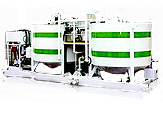
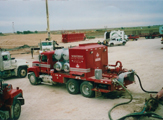
We can provide series of plunger pumps, mixing control systems and cementing equipment in truck-mounted, trailer-mounted or skid-mounted way, with max. pressure ranging from 5000psi(35MPa) to 14500psPa28100MPa) and max. displacement of 423~923gpm(1600~3500L/min). These products are mainly used for various cementing operations for deep, medium and shallow well of oil & gas fields, including self-made cementing slurry, cement pumping and mud displacement. They can also be used for fracturing operations for shallow wells.
Both single pump single engine cementing equipment for shallow wells and double engine double pump cementing equipment for medium and deep wells are available.
Two kinds of mixing system: Tornado mixing system and new generation recirculation mixing system.
Two kinds of control systems: Automatic density control system and manual control digital display system.
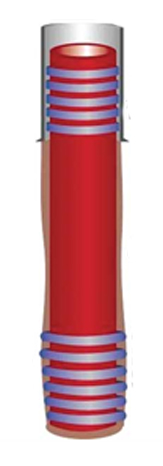
The BEST OIL TOOL CASING SCRAPER removes all mill scale, burrs, cement sheath, mud cake and any foreign matter from the inside wall of the casing forming a perfectly smooth and clean surface for the proper seating of packers. The number and the width of the scraping blades is so arranged that the tool scrapes 360° (full circumference) of the casing while being lowered into the well bore without the necessity of rotating if so desired. The scraper may also be run immediately above the bit while drilling out plugs.
The tool can be described as a two row, six to eight blade type. It is the simplest and most rugged scraper of its type available. These scrapers are manufactured from the highest quality alloy steel, properly heat treated. The blades are hard faced with tool steel and precision ground.
Liners have many applications and are run for various reasons. For example, they may be the best technical or operational alternative; they may be a cost- or time-saving alternative to casing; or they may help mitigate risk to the well or the environment.
Designing a liner hanger installation can be complex because it involves many variables; but the following Selection criteria are essential:
Size, weight, grade, and setting depth of casing.
Size, weight, grade, connections, and length of liner.
Setting depth of liner hanger.
Inclination of liner hanger.
Proposed trajectory of liner wellbore.
Size and weight of drill pipe.
Liner application.
Completion/stimulation operations after the liner are installed.
Loads applied to the liner hanger from the liner weight and from Hydraulic operations.
Completion and/or wellbore fluids to which the liner may be exposed.
Pressures and temperatures to which liner equipment may be exposed.
All of these considerations must go into the design of a liner system that will meet your needs while remaining within the operational capabilities of the equipment.
Production Liners
Production liners are used to hang production casing. Depending on the final well configuration and any completion or stimulation requirements, production liners will probably be exposed to more loads and for longer periods than any other type of liner.
Production liners must be compatible with completion products such as completion packers. They must be able to withstand additional loads imposed by completion/production enhancement operations (frac jobs or temperature cycles). They must also be compatible with all fluids and gases to which they will be exposed, including kill fluids, acid, hydrogen sulfide (H S), and carbon dioxide (CO) 2.
Production liners may be cemented, or they may carry pre-perforated pipe or screens. These liners are usually (but not always) run with a liner-top packer, depending on the completion and the type of well.
Interglobal Oil Services also offers many oil field accessories (e.g. Bumper Rings in 2-3/8", 2-7/8" and 3-1/2" sizes; Stabbing Guides in sizes through 20"; Pipe Chocks and Tubular Handling Systems)
Sabbing Guides
Bumper Rings
Pipe Chocks
Tector-Net Protective Netting
Ground Anchors
Interglobal Oil Services can Provide
complete Water Injection Systems for enhanced oil recovery, incorporating some of the Best Available Technology for each process item, including:
Coarse Strainers
Multi-Media Filters
Cartridge Filters
Chemical Dosing Packages
Deaerators
Control Panels
The water injection method used in oil production is where water is injected back into the reservoir usually to increase pressure and thereby stimulate production. Water injection wells can be found both on- and offshore. This method is used to increase oil recovery from an existing reservoir.
Water is injected for two reasons:
1. For pressure support of the reservoir (also known as voidage replacement).
2. To sweep or displace the oil from the reservoir, and push it towards an oil production well.
Water injection increases the percentage of the oil in a reservoir can be extracted (known as the recovery factor) and maintains the production rate of a reservoir over a longer period of time.